

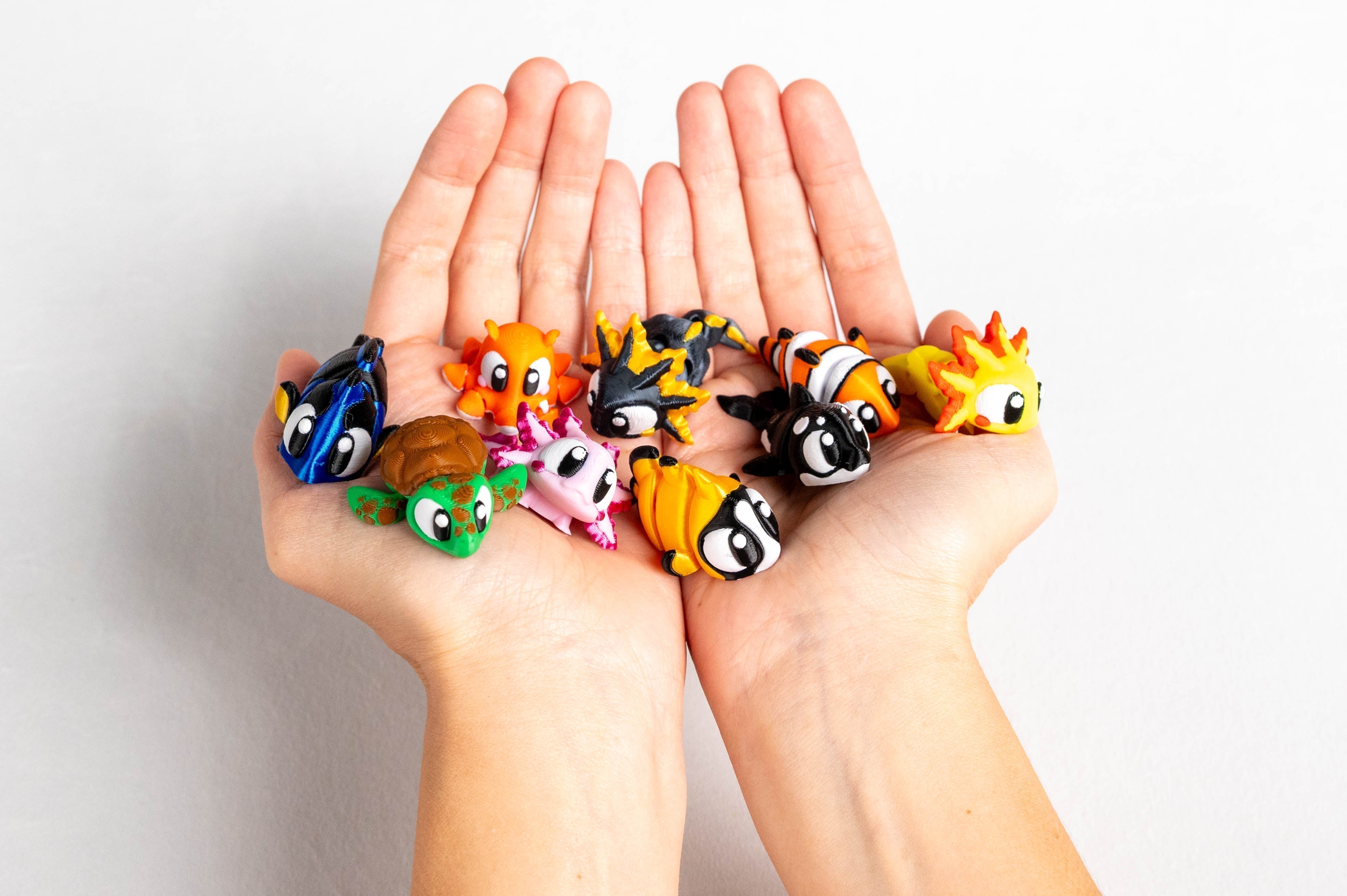
The fidget toy aisle used to live in the kids' section. Spinners, pop-its, squishy things shaped like food. Then adults started buying them too, for desks and meetings and long phone calls, and for the small daily reasons that nobody really talks about. This guide is for the adults who already fidget, who stim, who focus better with something in their hands, or who have wondered whether a small tactile object might quietly make the day a bit better. We'll cover what works, who reaches for what, and where 3D printed fidgets fit in.
Quick answers
Are fidget toys for adults a real category now? Yes. Search interest in "fidget toys for adults" has grown for years, with sharp peaks every April and December. Adults make up a large and growing share of fidget toy buyers.
Do fidget toys help adults focus? For most people, yes. They give a small parallel task to your hands, which lets the main task hold attention better. The pattern is well known in ADHD adults and broadly observed in everyone else.
Are 3D printed fidget toys worth trying? They are the fastest-growing fidget category, with search interest up over 300% in the last year. The articulated print-in-place design produces a tactile experience that moulded fidgets cannot.
How does quality influence the experience? The market is getting flooded by cheap unlicensed copies which should be avoided. What you get is usually a very small size and they break easily in your hand leading to frustration. Make sure the seller is providing enough information about the products, its size, quality, and origin. Buying a premium fidget toy with positive reviews will give you the best experience.
What kind of fidget should an adult buy first? Start with one. Pick something hand-sized for home, pocket-sized for work, and a texture you already gravitate toward. Most adults who end up with a small collection got there one toy at a time.

Rainbow Crystal Dragon wrapping around your hand.
Why fidget toys aren't a kids' category anymore
A few things shifted at once. Open-plan offices made it harder to focus without something to occupy restless hands. The autistic and ADHD communities became more visible online, and the conversation about fidgeting and stimming moved out of clinical contexts and into everyday ones. Working from home became normal for a large slice of the workforce, and that gave a lot of people the chance to notice how they actually focus, manage their energy, and get through a day. Search trends back this up. "Fidget toys" peaks every April, the same month as Autism Acceptance Month, and again at Christmas. Adults are buying these for themselves now, with names and reasons of their own.
A customer named Tara wrote a review last year that captures it. She bought one of our gold Book Companion dragons, a piece designed for shelves rather than pockets. "Reading the Anne McCaffrey Dragon books was a huge part of my teenage reading. Now I have my very own baby Ramoth to sit alongside my books whilst I channel my inner Lessa." That review reads as an adult collector buying a quiet articulated dragon to sit between her copies of Pern. The category has shifted because people like Tara are the ones buying.
Why adults reach for fidget toys
People pick up a fidget toy for different reasons. Some adults reach for one when their brain is moving faster than the meeting and they need somewhere quiet to put the extra energy. Some find that holding something with weight and texture takes the edge off anxiety, in the way some people pace and others knit. Some are stimming, in the simplest sense of the word, a small repetitive motion that feels good and helps the rest of the day make sense. Some focus better when their hands have something to do. None of these reasons need a diagnosis to be valid. The toy doesn't care why you picked it up.
Sensory seekers and sensory avoiders: how adults experience tactile input differently
Occupational therapists talk about a spectrum that runs between sensory seekers and sensory avoiders, and it is a useful frame for picking a fidget toy you'll actually use. Sensory seekers want more input. They like texture, weight, resistance, sound, things that click and snap and offer something back when squeezed. Sensory avoiders want less input. They prefer smooth surfaces, quiet motion, predictable shapes. Most adults sit somewhere in the middle, and the same person can swing between seeking and avoiding depending on the room, the noise level, the day.
The fidget toy market is built mostly for sensory seekers. Viral squishies, loud poppers, spinners, satisfying click toys, all of them assume you want more sensation rather than less. If you have tried a few popular fidgets and found them annoying instead of helpful, you are probably closer to the avoider end of the spectrum. Articulated figures sit in the quieter category. They move, they have texture, they don't demand anything.
A customer named Pamela described her Baby Rose Dragon in Paua Pearl this way: "The way the colors shift and change in different lights and with movement is mesmerizing." That word, mesmerizing, comes up often in our reviews of the colour-changing finishes. It captures something specific about the seeker experience, a slow flow of visual input that pairs with the tactile click of the joints. Avoiders may prefer the matte finishes, where the same articulation gives you the click without the visual demand.

Paua Pearl Baby Rose Dragon with colour-shifting
These dragons are beautiful to look at, which turns them into real collectibles. Some dragon trainers give them names and make up whole stories around them.
Fidget toys autistic adults actually pick up
Autistic adults have been using fidget toys forever, with or without that label, with or without anyone giving them permission. What has changed is that the products on offer have caught up. Adult-sized, adult-aesthetic, properly tactile fidget toys are now their own market segment.

Baby Sunflower Dragon with satysfying tactile tail.
The patterns we see at conventions and in customer feedback are consistent. Autistic adults tend to gravitate toward fidgets with predictable repetitive motion, satisfying tactile feedback, and enough physical presence to fill a hand. An articulated dragon has dozens of small joints that move with a soft click, give a consistent sensation when you run your fingers down the body, and offer something to do with both hands at once. Articulated octopuses, snakes, and other long-bodied figures work the same way. They reward attention without demanding it, and they hold up to thousands of hours of fiddling.
Our articulated dragon collection is the most-loved by adult fidgeters in our customer base. Hand-sized to large, dozens of articulated joints, smooth tactile motion. View the collection →
Fidget toys ADHD adults reach for
ADHD adults often have a different relationship with fidget toys. Where autistic fidget use leans toward steady, predictable, repetitive input, ADHD fidget use often leans toward novelty and variety, something that occupies the part of the brain that isn't on the task. The classic ADHD adult description is wanting to channel restless energy somewhere that isn't disruptive. The meeting fidget. The desk fidget. The small object that lives in a pocket and gets pulled out twenty times a day.
What works tends to be smaller, quicker, more discreet. Single-hand toys that can be operated under a desk during a video call. Toys with multiple modes, so the same object stays interesting across a long workday.
A customer named Janice left us a one-line review of her Ice Cream Dragon last year. "Absolutely love it, it keeps over me each day at work." That sentence does a lot. A small dragon, sitting on a desk, watching over the workday. ADHD adults often describe their best fidgets in similar terms, as a presence rather than a tool. The articulated fiddly toys we make are popular for the same reason. Small enough to hide in a fist, complex enough to stay interesting, quiet enough to not interrupt anyone.
Our Fiddlies collection is built for desk and pocket use. Small, discreet, complex enough to stay interesting through a long day. View the collection →
3D printed fidget toys: the tactile option that's gaining ground
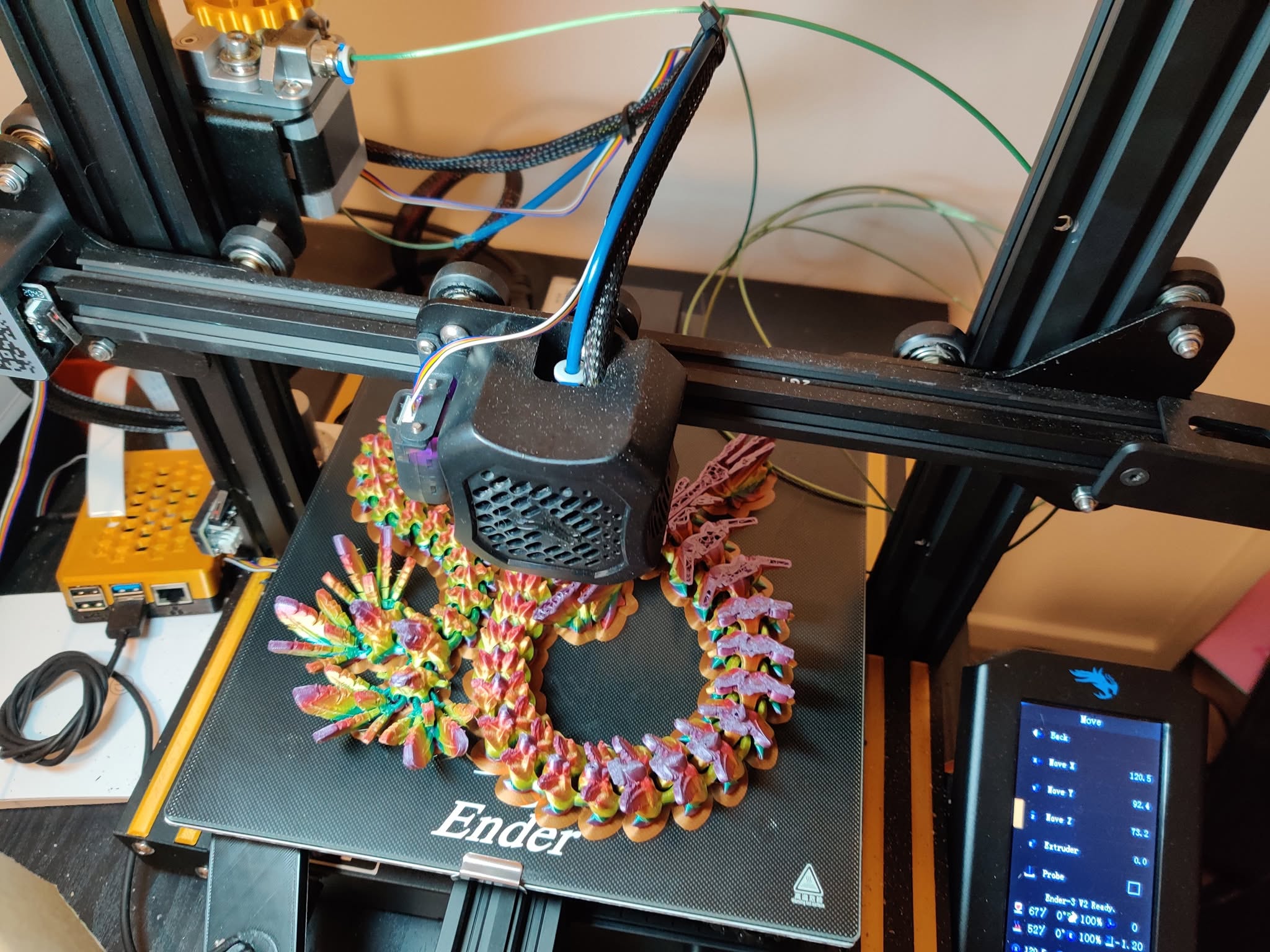
3D printed fidget toys are a relatively new category, and they are growing fast. Search interest in "3D printed fidget toys" has risen by more than 300% in the last year, which tracks with what we see in our own sales. The reason is mechanical. A 3D printer can produce articulation, flexible joints, and complex geometry that injection moulding either cannot do or cannot do affordably.
The tactile experience is genuinely different from a moulded squishy or a metal desk toy. A print-in-place articulated figure has small layer lines you can feel under your fingertips, joints that move with a low-frequency click, and a slight flex through the body that gives it a living quality. For some adults this is the sensation that finally clicks. Print-in-place mechanisms also mean every joint moves independently from the moment the toy comes off the printer. No assembly. No parts that can come apart and get lost.

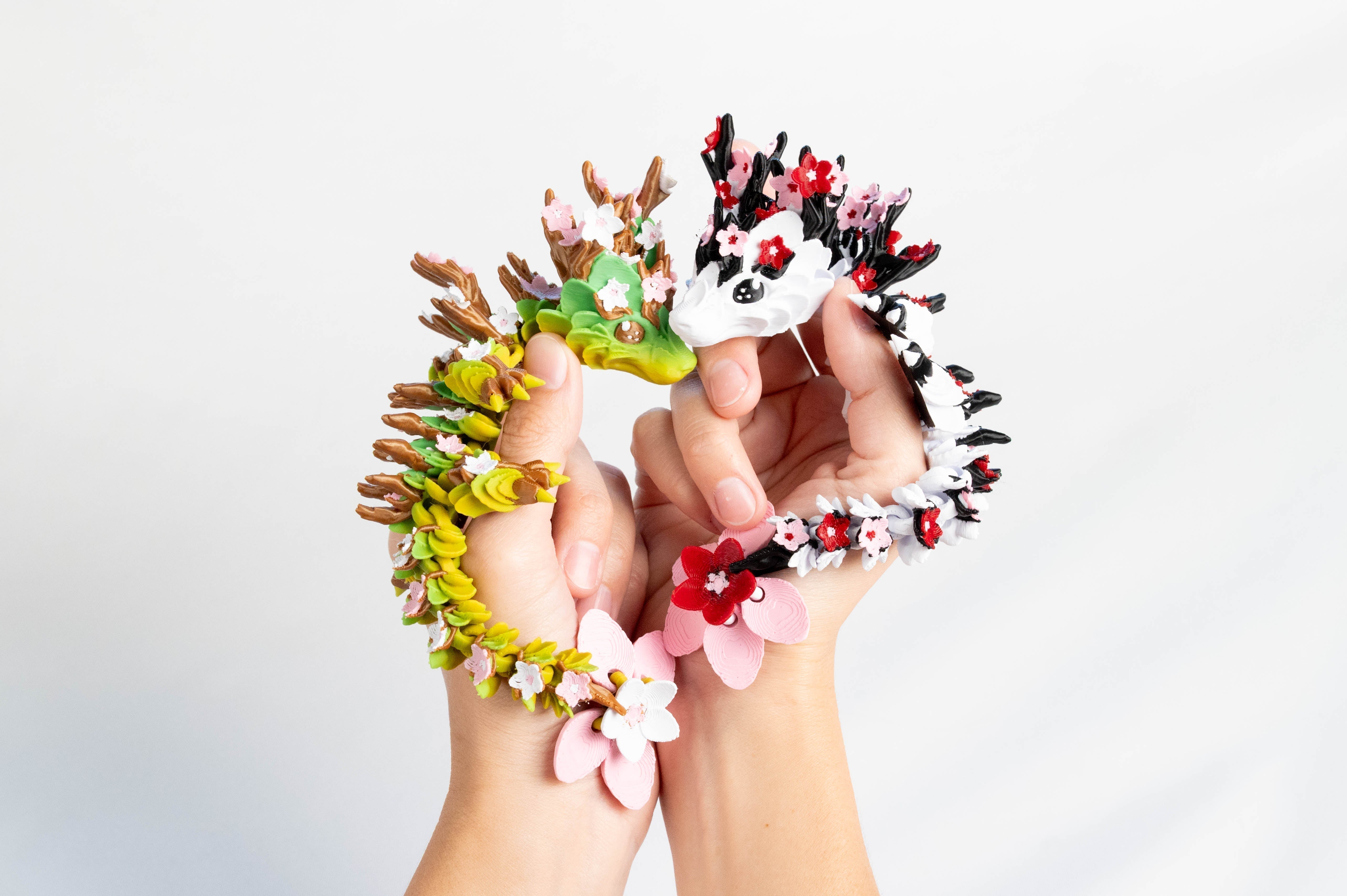
So many colour choice for the Baby Cherry Blossom Dragons.
The other thing 3D printing changes is variety. Turtle Creations provides dozens of shapes, sizes, and finishes, and choose the one that resonates the most with you. We learned this on the convention floor before we learned it from the data. People at the Armageddon Expo will hold five different dragons before deciding which one comes home, and the choice is rarely about size or articulation. It is about which one they want to look at every day.
| Fidget category | Texture | Best for | Volume |
|---|---|---|---|
| 3D printed articulated | Layer lines, click joints | Steady tactile, two-handed use | Quiet |
| Soft moulded fidgets | Smooth, yielding | Quick stress release | Silent |
| Metal desk fidgets | Cool, weighty | Desk-bound office use | Quiet to medium |
| Spinners | Smooth-rotating | Visual and fine-motor input | Quiet |
| Pop-its | Bumpy, tactile | Repetitive satisfaction | Loud |
How quality changes the fidget experience
The 3D printed fidget market has a problem. Unlicensed copies of popular designs flood marketplaces, sold at suspiciously low price, and the quality usually shows the moment you take them in your hand. The figure is smaller than the photos suggested. The joints are stiff or loose. The print quality is rough enough to leave layer fragments on your fingers. Worst of all, the articulation breaks after just moments of fidgeting.
What to look for before you buy. A seller who tells you the actual size, names the material, and shows the figure in someone's hand. Real customer reviews with photos that match the product page. A clear origin and a real human behind the brand. The reviews tell you whether the articulation actually holds up, or whether you're going to be in the comments section asking for a refund. Pay a little more for a fidget toy from a seller you trust. The good ones become daily companions. The cheap ones become the reason you stopped trying.

Red Monarch Baby Butterfly Dragon made with our multimaterial system with premium finish.
How to choose your first fidget toy (or build a small collection)
The honest advice is to start with one and see how it goes. Most people who end up with a small collection got there by accident. They bought one fidget that worked, then a second that worked differently. There is no need to buy a starter kit.
If you want a working framework, watch your hands during a quiet moment. If you find yourself running fingers along the edge of a desk, picking at a label, or rolling something between your fingers, your hands have already told you what they want. From there, pick something hand-sized for home and pocket-sized for work. The big satisfying fidget for the couch is rarely the same as the discreet fidget for the meeting. Whichever you choose, give it two weeks before deciding whether it works. The novelty of a new object can mask whether it is actually doing something useful.
Share:
What Is a 3D Dragon? Your Complete Guide to Articulated Dragons
Best 3D Articulated Dragons in 2026: A Buyer's Guide
About the author
Martin Novak
Co-founder & Chief Dragon Trainer · Turtle Creations
Martin and Petra are two New Zealanders, who founded Turtle Creations in 2022 and grew its business from a single 3D printer to a well-respected 3D printing company. Martin handles most of the technology related to 3D printing, automation, and the website. He now has years of experience crafting dragons and fidget toys which he now shares on the Turtle Creations blog.